
In brief
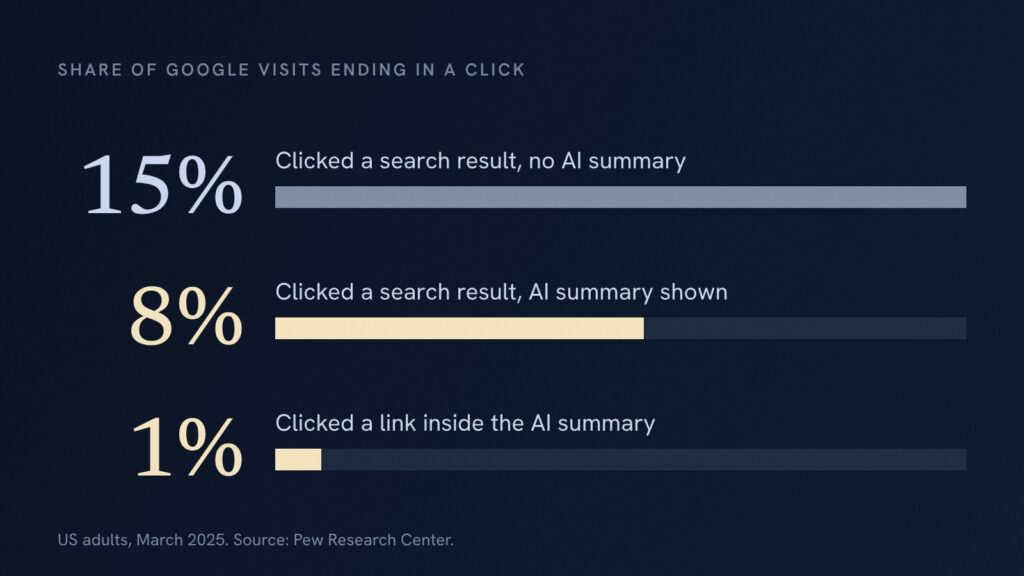
- When Google shows an AI summary, clicks on search results nearly halve, from 15% of visits to 8%. Links inside the summary are clicked in just 1%.
- AI is now part of the student search: 23% of US graduating seniors used it in 2025, and 59% of postgraduates in a small Edinburgh survey.
- The fix sits in our own content: deciding facts in plain page text, one true answer per fact, and a monthly check of what AI tools say about our courses.
For most of my career, the job has been to earn the click. Rank for the search, write the snippet, build the page that turns a curious visit into an enquiry. That model is wearing thin. More and more, a prospective student’s first conversation about a course happens in an AI answer, before they ever reach a university website.
Fewer clicks, earlier decisions
The shift is measurable. When Pew Research Center tracked the browsing of 900 US adults in March 2025, people who saw an AI summary at the top of Google clicked through to a traditional result in 8% of visits. Without a summary, they clicked in 15%. Links inside the summary itself were followed in just 1% of those visits.
Students are moving faster than the rest of us. In the US, Carnegie’s research found the share of graduating high school seniors using AI in their college search rose from 4% in 2023 to 10% in 2024, then 23% in 2025. Closer to home, the University of Edinburgh’s prospective student web team surveyed 97 people about how they searched for degrees. Of those, 38% had used AI tools. Among postgraduates, the figure was 59%.
The machine reads what we publish
Edinburgh’s write-up deserves a wide audience because it is honest about what went wrong. Entry requirements on their new degree finder sat behind dropdown menus, so AI tools often couldn’t read them. In one case, ChatGPT gave incorrect entry requirements for politics, taken from a private tutoring website.
That is the whole problem in a single example. An answer engine isn’t hostile. It is literal. If the real answer is hidden in a dropdown, a PDF or a script, it will find an answer somewhere else and deliver it with the same calm confidence.
If we don’t publish the answer clearly, something else will answer for us.
What I would change first
- Put the deciding facts in the page itself. Entry requirements, fees, duration, start dates and modes of study belong in the text of the course page, not loaded on demand or locked inside a PDF.
- Keep one true answer per fact. Retire the old PDFs, stale microsites and duplicate pages that contradict it. An AI tool can’t tell which version you meant.
- Answer the questions people actually ask. “Can I study this part-time?” and “What grades do I need?” deserve direct, quotable answers near the top of the page.
- Treat AI as a channel. Track referrals from ChatGPT, Gemini, Perplexity and Copilot separately, and ask applicants where they first looked.
- Check the answers every month. Ask the main AI tools about your biggest courses, log what they get wrong, then fix the source rather than the symptom.
The click still matters
None of this means the website is finished. Edinburgh saw no overall fall in visits year on year, and the AI referrals it did record grew from about 200 in March to about 1,300 in August, with results season playing its part. The people who arrive have already done their homework. They come with sharper questions and firmer intent.
So the measure changes. Traffic still counts, and accuracy now counts for more. Wherever a student meets an answer about one of our courses, it needs to be correct, current and ours.
The last click still matters. It just isn’t the first impression any more.
Comments
No comments yet.